Welcome to our blog! This blog is co-written by Natalie Rich and Lizzy Douglas during the spring of 2013. We will be student teaching in Guiyang, China for 8 weeks. We invite you to follow our blog to learn about our adventures teaching and traveling abroad.
This blog post was co-written by Natalie and Lizzy.
When Lizzy and I (Natalie) learned we would be student teaching in Guiyang, we were thrilled because Guizhou Province is home to over 40 different ethnic groups. With many villages to explore in the countryside and a variety of special dishes to sample, we were excited to book a tour (with help from our supervisor and friend, Candice) to Xijiang, a Miao Village about four hours east of Guiyang. Lizzy was also looking forward to hosting our first visitor to Guiyang: Melissa, Lizzy's friend from Shanghai. Lizzy and Melissa met many years ago at Chalk Hills Girl Scout Camp in northern Wisconsin.
Lizzy and Melissa: Old friends on a new adventure
April 4 marked the annual Qingming Festival, basically the Chinese Memorial Day. We had a three-day weekend: Thursday, Friday and Saturday. Since Friday wasn't a holiday, school was in session on Sunday. Thankfully Friday's are early dismissal and I'll only be there until 11:45, plenty of time to enjoy a Sunday afternoon.
Close-up of Miao Architecture
The Qingming Festival is also known as Ancestor's Day or Tomb Sweeping Day. It falls on the first day of the fifth solar term. Not only is it a day to tend to the graves, it is also a day for people to go outside and enjoy the springtime. Qingming designates the time to observe the warming temperatures and plants blooming; the beginning of spring. As our bus made its way through the countryside, we could see families cleaning the graves of their loved ones. Offerings such as food, tea and wine are left. Some families place willow branches on their front doors and gates to ward off an evil spirit that comes during this festival. Ancestor worship is common China. Many shops in Guiyang and in the countryside sell white decorations to be placed on tombs to honor passed family members. White is regarded as the color of death in Chinese culture.
Here is a link to a slideshow from the New York Times featuring interesting facts and photos from the Qingming Festival.
The Miao are of special interest to Lizzy and me because there is a significant Hmong population in the United States, specifically in Wisconsin (Lizzy's home state) and in Missoula. The Hmong are one of the sub-groups of the Miao when they migrated from China to Laos and Cambodia. We also took a class last summer that required us to read Anna Fadima's The Spirit Catches You and You Fall Down: A Hmong Child, Her American Doctors, and the Collision of Two Cultures. This book gives insight on Hmong culture and highlights some of the general culture differences that Lizzy and I are experiencing daily.
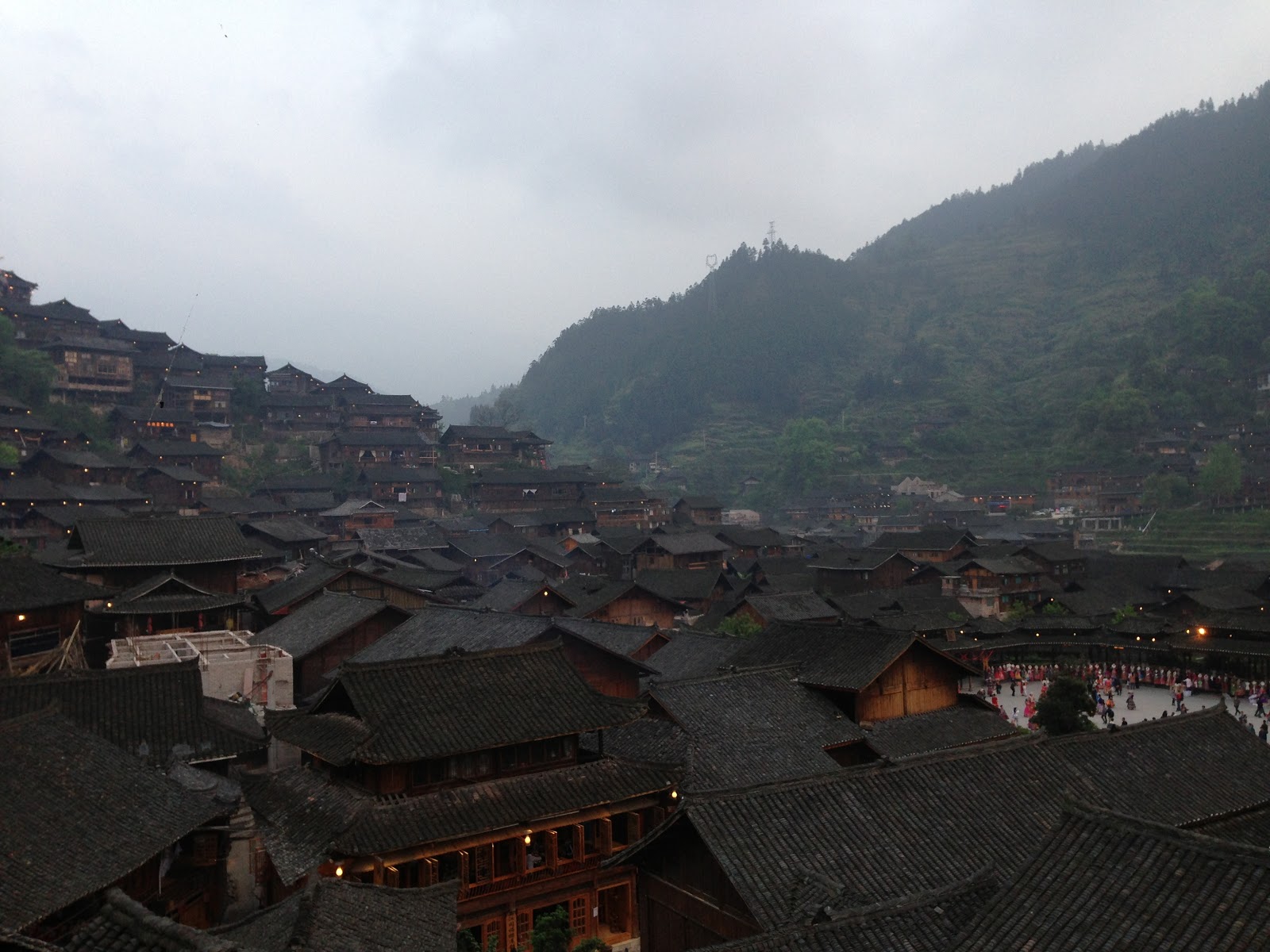
Xijiang, Miao Village
Our tour was booked through the company the school uses for events and field trips. Priced at about $56 per person, the two day excursion was a steal. The bus ride, admission to the village of Xijiang, two lunches, one breakfast, one dinner, our accommodations and entrance fee to Jianhe Hot Springs were all taken care off. The only hitch: we were told our guide spoke a little English but when in reality he spoke as much English as we do Chinese. Communication and understanding is a group activity.
Street in Xijiang, Miao village with food vendors and shops
The tour was very laid back, even dogs were allowed to join in on the fun!
Our bus seat neighbors
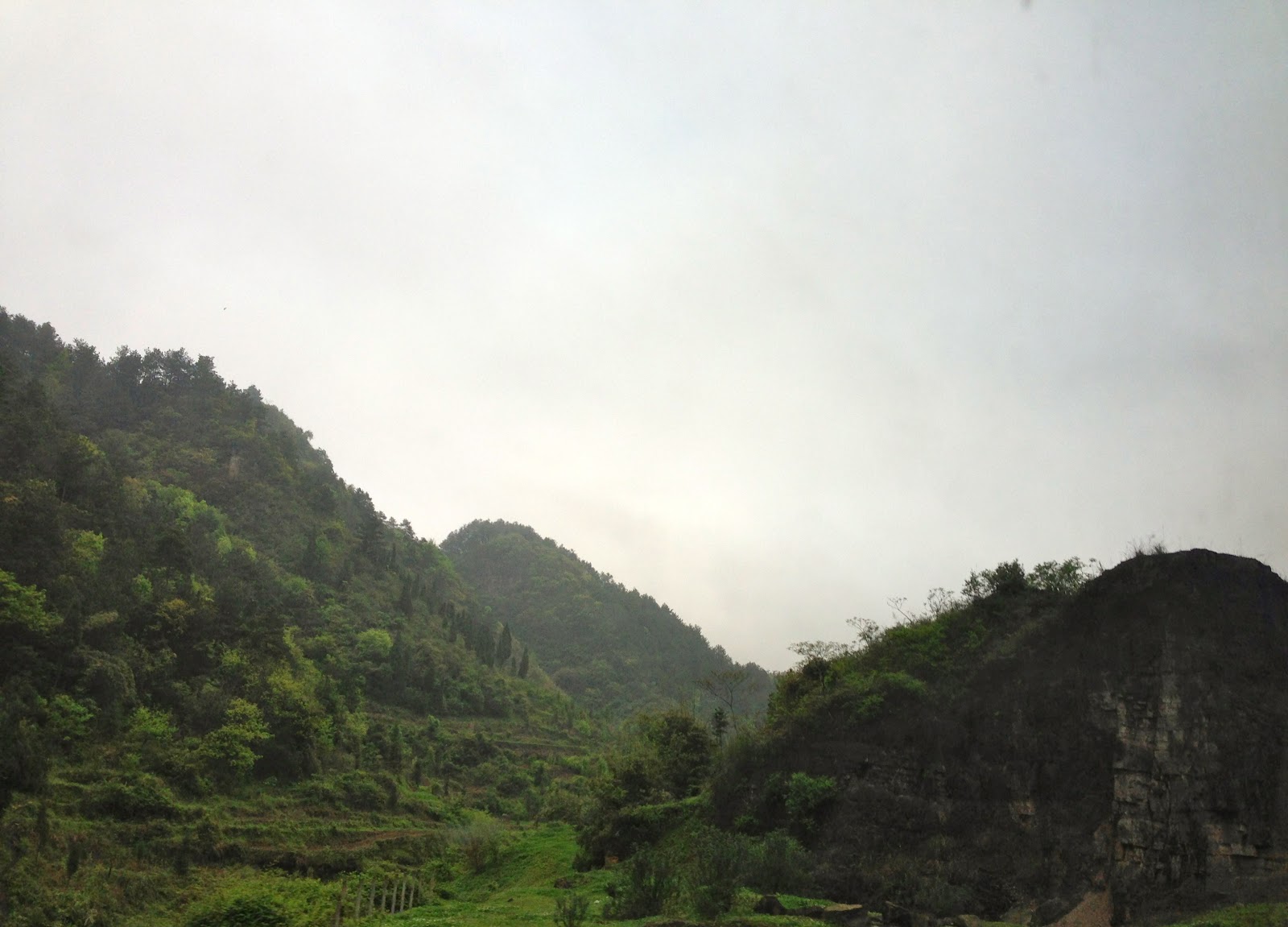
Lizzy, Melissa and I were armed with snacks, some known and some unknown to entertain us on the ride. The drive was absolutely gorgeous. The countryside here is unlike any place I have ever seen. It's is lush and mountainous with varying shades of green. The ancient limestone has weathered away to leave triangular mountains, steep valleys, and rolling hills. The bus ride was bumpy and foggy but I managed to snap this picture.
The countryside from our bus
Xijiang is the largest of the Miao villages and is known as the "One-thousand-household Miao Village." The Miao are known for their colorful embroidery, weaving, intricate silver-smithing and wooden stilted houses. We are familiar with their famous embroidery techniques from those we have seen done by the Hmong in the US.
Miao silver shop
A conscious effort has been made to accommodate visitors in Xijiang as we were greeted by a sizable parking-lot with restrooms. Our guide gave us tickets to enter the village and then we all boarded trolleys to take us closer to the town.
Things got a bit confusing as our guide was nervously attempting to tell us the itinerary for the day. We were good with following the herd but what about when the herd dispersed?! We did our best to stick with people in our group, but it wasn't easy because the concept of lining up and waiting for people in front of you is not often followed by the Chinese. Every man or woman for himself.
Natalie, Lizzy, and Melissa at the Miao Culture Museum
One painting in a set of Miao religious displays
Our travel guardian angels were looking over us once again as a lovely couple, English names Jen and John approached us and demonstrated their English skills. They are currently medical students studying in Guiyang. We walked together to a museum and then it was decided that the five of us would check out the village together. Jen and John were wonderful and kind. They took it upon themselves to share street snacks they thought we should try and even went so far as to help us with bargaining in the shops. Their English was limited but with the use of a translation app on Jen's Smartphone, they translated and gave us as much help and information as they could.
Natalie communicating with Jen and John. If Lizzy wasn't capturing the moment, she'd be pantomiming. It takes a village to communicate the simplest things.
We had a great day wandering. We enjoyed watching the merchants create items that would soon be for sale in their shops. We saw silversmiths soldering and women weaving beautiful scarfs. The Miao adorn themselves with elaborate silver headdresses. Their purpose is mainly aesthetic but the silver is also believed to ward off evil spirits.
Miao weavings shop. Woman weaving on a loom in the front of the store.
Traditional Miao clothing with silver headdress and adornments
At the edge of the village I (Lizzy) was excited to see a valley full of rice and taro paddies. Both rice and taro grow in water and mud and require regular care. This time of year people are transplanting rice seedlings into the paddies. Families work together to plant rice. Paddies were at various stages of weeding, irrigating, digging, and planting. Rice is staple food for the Chinese and much of the province is not farmable, so they must carefully use all available land to feed to large population.
Rice paddies outside of Xijiang, Miao village
Natalie, Melissa, and Lizzy outside Xijiang, Miao village
Miao people transplanting rice seedlings
Thanks to Jen and John, we knew that there was a performance in the village square at 5:00 and dinner would follow. We arrived at the square just in time and were astounded by the crowd!
Crowd of tourists in the Miao village square
The costumes were beautiful. Men and women Miao performers were dressed in traditional outfits with modern adaptations. They danced, sang, and and played instruments for nearly an hour. The crowd was delighted by the incredible choreography.
Miao Performance
Miao performers
Miao performers
Miao performers
We were, however, surrounded by stands where you could dress up in the Miao costumes and have a photo taken, similar to "Old-Timey Photos" back home. I found my mind beginning to piece together a ticket to enter a village plus photos in traditional clothing and realize that the flood gates to tourism have been opened and encouraged. It seemed another contradiction of modernity and traditionalism, a common theme in Guizhou Province.
Traditional Miao dresses that tourists may try on and photograph for 10 RMB.
Melissa, Lizzy, John, Natalie, and Jen
A traditional Miao long table dinner followed the performance. We had read about a Miao tradition of drinking rice wine and were very curious. As dinner was winding down, two Miao women joined our group. They theatrically sang to each of us (a form of a toast) as they poured the rice wine into a small dish and gently poured it down our throats. Apparently, it is considered rude to refuse the drink. After a few more minutes, I noticed that everyone had stood up and left the table. Lizzy, Melissa and I were dumbfounded and proceeded to enjoy the dinner but then we heard the singing again. I looked over and the Miao women stood before me with another small bowl of rice wine and followed it with another. Finally, John and Jen suggested we get up or eventually we wouldn't be able to!
Jen and John invited us to join them on a trolley ride up to an overlook to see Xijiang at night. We watched the lights flickering on the hillsides, a good perspective on the size of the village.
Xijiang, Miao Village at night
Xijiang, Miao Village Night Market
Xijiang, Miao Village Street Food
The excitement came, however, when we tried to catch a trolley back down to the village. An empty trolley rolled up and as we walked over to it, a large group of people ran and filled it so quickly, we couldn't believe our eyes. It was as if a magnetic force pulled them from the crowd. People fought for seats, it was unreal and absolutely hilarious. We watched as another trolley pulled up and as people exited, more people fought to get on. No holds barred. We finally decided that we had to be aggressive or we would be walking down the mountain. The next trolly arrived and low and behold our group of five made it! We were all VERY proud of ourselves. China is full of small personal victories!
The excitement continued as we headed to our Miao Guest House for the evening. Three twin wooden beds, greeted us as well as a massive spider. We found some locals to help us and our intention was to get it outside by opening the window. One woman handled the spider with a hanger as Lizzy, Melissa and I all shrieked in horror.
Stilted house guest room. The communal bathroom was in the hall/outside.
Exhausted from the day's events, we all slept well despite the hard wooden beds. The view of the Xijiang was stunning in the morning. A gentle mist hovered as it rained on and off.
View from our stilted house (hotel) of Xijiang in the morning
Xijiang in the morning
After a breakfast of delicious sour noodles, we boarded our bus. We were curious because our next stop was Jianhe Hot Springs, a sacred Miao bathing site. Lizzy and I love visiting hot springs in the US and we wondered what the experience would be like in China.
Miao boy selling steamed snails for breakfast in Xijiang, Guizhou Province
The bus drove about two miles and stopped. Everyone was getting off. None of the public announcements by our tour guide were translated into English, so we were very confused and when we were whisked into a tiny room for a presentation on cleaning products, toothpaste, underwear, and neck pain relief. We realized that this was the part of the tour when we are encouraged to buy from a place that's in cahoots with the tour company. The presentation was boring and we waited outside as people entered a dark shop. John and Jen finally clued us in that the only exit was through the store. I don't know why the lights were off but I walked through people happily shopping in this pitch black labyrinth of aisles and aisles of cleaning and personal care products.
Dark shop at the end of the village
The drive from Xijiang to the hot springs was exhilarating to say the least. Our bus took hairpin turns on a one-lane road at maniacal speed. Our Chinese bus mates did not seem in the least concerned about the on-coming traffic, steep cliff above a river, nor the lack of guard rails. It was impossible to take any photographs, let alone remain comfortably in our seats. Infrastructure in China is still catching up with the increase of personal vehicles and public transportation, so the roads and highways are covered with potholes, broken concrete, and other hazards. We were glad to finally stop for a brief lunch and then proceded to the hot springs.
Hot Pot Lunch
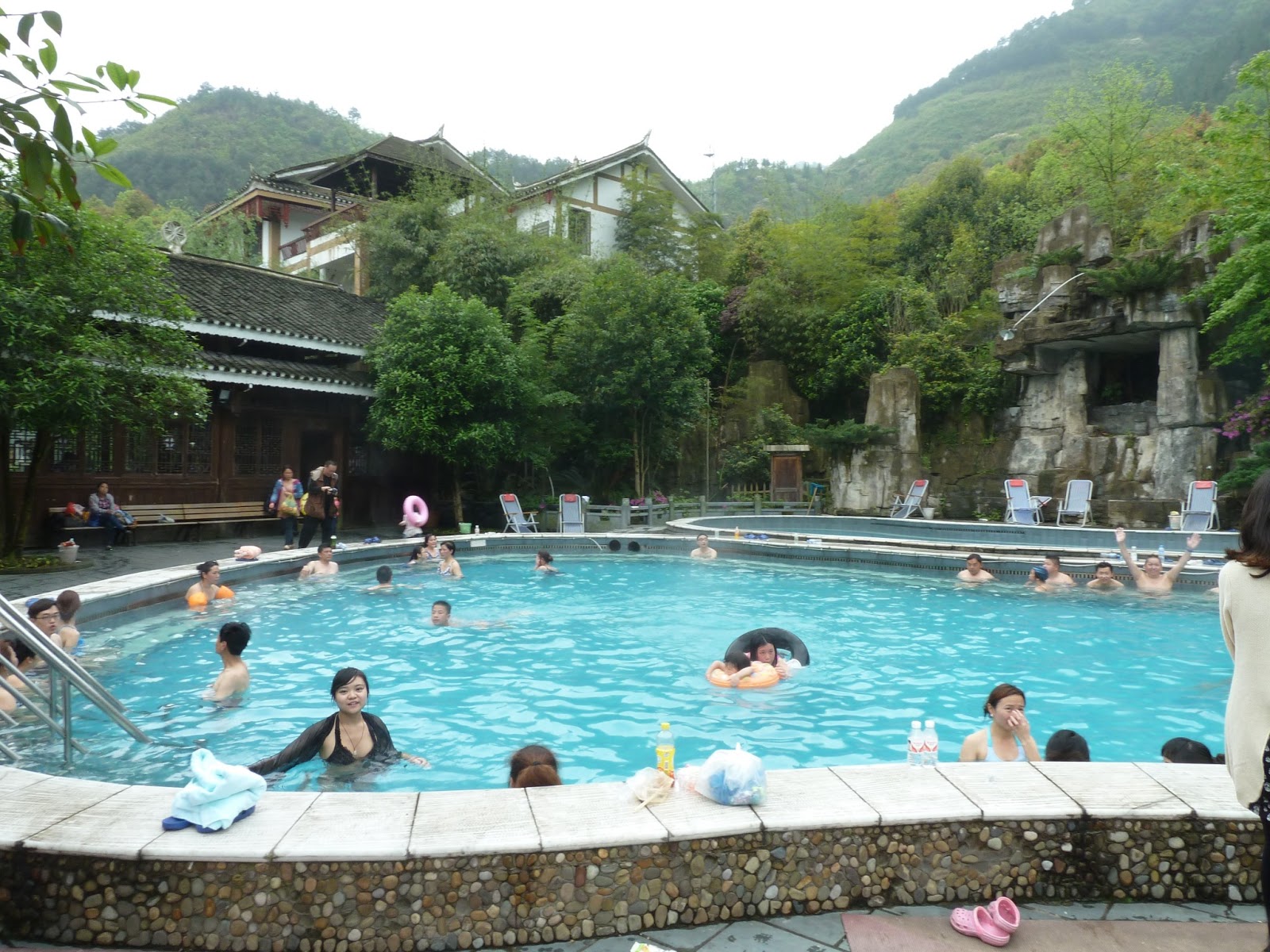
Natalie and I (Lizzy) were warned that the water at the hot springs was great, but that the facilities were "backwards." I've seen quite a few hot springs in Colorado, New Mexico, and California, some of which were "natural" and some built up like swimming pools. The Jianhe Hot Springs were quite nice in comparison with many US hot springs. The pool was clean and we were provided with a personal locker to store our belongings. The changing rooms and shower rooms were overcrowded, but that's to be expected in China.
Jianhe Hot Springs, Guizhou Province
Entertaining Chinese-to-English translations are an endless source of laughs. This was one we chuckled about for awhile.
Women's shower at the Jianhe Hot Springs
The drive back to Guiyang was long and tiring. Because it was a holiday weekend, all the toll roads were free, thus causing major traffic problems on country highways. We returned to our hotel in Guiyang around 7pm. $56 was well worth the great experience we had seeing the countryside and visiting the Miao village.
Go team +2! We don't know two of these girls, they simply wanted a photo with us. Now they are famous on our blog :)
Travel tips for trips taken with a tour company:
It may be an option to hire an English-speaking guide but the cost is considerably higher.
Bring at least four extra bottles of water for the long and unpredictable bus ride.
Bring snacks.
Carry extra tissue.
If you are sensitive to noise, bring earplugs - the bus can be loud.
Ask your hosts for recommendations on tour groups.
Your hotel can also arrange tours.
You will be required to stop in a store to buy things at the end of the tour. Do not feel pressured to purchase anything.
Weekends are precious to teachers around the world. Natalie
and I decided to spend Saturday exploring Guiyang. We started at the Guiyang Provincial
Museum, which is about four blocks from our hotel and opened recently. We were
pleased to discover that there was no entrance fee and many of the information
signs had an English translation. The museum focused on 17 of the cultural
minorities in China and significant paleontological findings in the province. The
Han Chinese are the ethnic majority in China and live in nearly all parts of
the country. The government is working to protect the 55 total ethnic
minorities in the country. The museum displayed different types of musical
instruments, weapons, metal work, embroidery, weaving, traditional dress, and
scenes that were specific to each culture. The museum also had an interesting
collection of early human artifacts, bones, and teeth. The Guizhou region is
home to unique karst topography and many Cambrian fossils similar to those
found in the Burgess Shale. I was happy to learn a bit more about the local
geology.
One of our goals for the day was to locate Highlands Coffee,
an American-owned and run coffee shop in the city center. A short taxi ride
later and we were there. Across the street from the coffee shop we saw a large
square of people and a golden building, so we decided to investigate.
Renmin Square (People's Square) is a huge stone plaza in the middle of the city on the Nanming River. The square was full of kite vendors and people running willy nilly flying kites. The Chinese have a tradition and love of kite flying. I was amazed that very few kites got crossed and even fewer people were clotheslined.
People flying kites in Renmin Square (People's Square)
At the edge of Renmin Square was the cultural minority performance center modeled after a traditional reed piped wind instrument.
Cultural performance center modeled after a traditional wind instrument
The truly serious kite flyers were a group of elderly gentlemen sitting on a bench whose kites were so high in the sky that we couldn’t see them.
Kite flying is not just for kids. These men are pros.
At
the opposite end of the square was one of the largest statues of Mao Zedong in
all of China. Ironically, underneath the square was the largest Walmart.
Mao Zedong statue
Back at the coffee shop we enjoyed some tea and wifi to
figure out our next move. Just as we were about to leave an American fellow
joined us. Evan, who currently lives in Beijing but is originally from Georgia,
told us he’s passing through Guiyang on a tour of China doing research for his
first book about traditional Chinese pickling and fermentation techniques. Are
you kidding? I couldn’t believe our luck! I too am interested in fermenting and
preserving foods. The first American we have seen in three weeks turned out to
be a foodie who speaks fluent Chinese! We swapped stories and he gave us a few
tips for getting along in China. We made plans to meet for dinner and parted
ways for the rest of the afternoon.
Qianming Si, Buddhist temple on the Nanming River
The city center is full of interesting places to visit. We
wandered in a general northeast direction and found a fascinating market
outside a Buddhist temple, Qianming Si. The market had a number of traditional
herbs, roots, and other remedies for sale, including dried lizards. Other
tables sold false teeth and on-the-spot dental work. Outside every Buddhist
temple are vendors selling long sticks of incense and long red candles that
people use during prayer and meditation. There was even a ring toss game for children. Something for everyone! Teeth, spirituality, trinkets, veggies, underwear, etc. Anything you could want is sold on the street in China.
Ring toss outside the temple
Guiyang is currently under going a
major building phase. Temples and pavilions from the 1500 and 1600s are next to
shopping malls and high-rise apartment complexes. The mix of ancient culture
and modernization is fascinating.
Walk along with Nanming River
About a ten minute walk along the banks of the Nanming River
past Qianming Si was the famous Jiaxiu Pavilion. The ancient tower was built in
1589 on a small rock in the middle of the river and connected to the north bank
by the Floating Jade Bridge (Fuyu Qiao).
Lizzy and Natalie walking along the Nanming River with Jiaxiu Pavilion in the background
Jiaxiu Pavilion was built for the
purpose of being a meeting place for scholars. It currently serves as a tea
house and museum of ancient scrolls. The building is often considered the symbol of Guiyang. I resisted the urge to sing "Sur le Pont d'Avignon" as we walked over the bridge, but Natalie did oblige me a Singing in the Rain photo.
Jiaxiu Pavilion and Floating Jade Bridge
Singing in the Rain in Guiyang: Lizzy with Jiaxiu Pavilion in the background
On the south bank of the river lies the Cuiwei
Gardens, built around 1500 originally as part of a Buddhist temple. While we
could not read any of the signs, we enjoyed the stunning architecture of the
historic buildings and courtyards. We hope to return to enjoy some tea at
Jiaxiu Pavilion at night while we are here. The city lights up both the
three-story tower and the skyscrapers to display a dazzling light show along
the river each night.
Cuiwei Gardens with Jiaxiu Pavilion in the background
Cuiwei Gardens
Using Natalie’s great powers of urban navigation we made our
way on foot from the banks of the Nanming River back to Hunter City Shopping
Mall. Only a couple of times did we stop people on the street to make sure we
were headed the right direction. Asian people have varied reactions to being
approached by foreigners, but the people of Guiyang have been helpful and kind.
After picking up some provisions in the mall we met up with
our new American foodie friend, Evan. He excitedly shared with us his “best day
yet”. His three-week trip is coming to an end in a couple of days and he was
pleased to have met a master pickler at a local market who sent him home with a
homemade batch of fermented vegetables and a Gatorade bottle of broth. Since he
both reads Chinese and knows about food, we confidently let him choose a
restaurant for dinner. We wandered up and down streets and eventually ended up
at a great dumpling restaurant. Evan swiftly ordered all the food in Chinese
without any of the awkward pointing, gesturing, and phrasebook referencing that
typically accompany our meals. It was great to talk to another native English speaker
for a few hours. At the end of the night we parted ways and wished Evan well on
the last leg of his trip. I look forward to picking up a copy of his book soon!
Back home, we take field trips by class or grade. At Guiyang No. 4 Experimental Primary School, we stick together as a school, all 1,000+ of us. Due to the language barrier, we could not understand the buzz in the hallways or take part in the orchestration of such a large undertaking. In addition to all faculty being involved, several policemen were on hand as well. Lizzy and I were instructed to enjoy. And we did.
Lizzy and I with the cops. Don't buy their tough guy looks. They were smiling and playing with the children all day.
This video is an overview of our day featuring photos and footage. It begins with the students getting ready to board the buses, Lizzy entertaining them with a quick lesson on how to do the "Hand Jive" and pictures from the temple and picnic. For something different, I put it to music and chose Eddie Vedder's cover of "Hard Sun" from the Into the Wild soundtrack because it was in my head all day. Enjoy.
It took over 30 buses pre-arranged through a travel company to transport us from school to Kongxuetang, a Confucian Temple. We waited on the grounds for everyone to arrive while Mrs. Chen, one of the headmistresses, gave a speech that I’m guessing was about the temple and behavior expectations. Once all of the classes had ascended up the stairs, the students, under the direction of their class leader, queued up and we moved, one class at a time, swiftly through the temple.
Confucius (551BC – 479BC) was an educator and philosopher who valued personal relationships, morality, sincerity and justice. His most notable teaching is still taught in education systems and religions worldwide:
The Golden Rule: What you do not wish for yourself, do not do to others.
Humanism is the basis of Confucianism. Five main virtues are practiced:
Rén (Humaneness)
Yì (Justice)
Lĭ (Propriety)
Zhì (Knowledge)
Xìn (Integrity)
It is a blessing in disguise that Lizzy and I cannot read Chinese because we would’ve wanted to spend the entire day reading every character on the premises. Instead, we were whisked away to a picnic.
The picnic was on the bank of a river at a wetland park, gorgeous scenery and a large enough space to accommodate 1000 students! The school packed our lunches and the students brought their own.
The students took picnicking to a whole new level. We watched as the kids sat in groups of 8-10 and dumped everything they brought out of their backpacks and into the center of the circle. We’d never seen so much food! We were impressed and naturally wanted to take photos to share with folks back home for picnic inspiration.
Pizza?!
As we walked around, students walked up to me and gave me Hershey’s Kisses (score!) and some pieces of candy. I must have been moving too quickly, snapping photos. I turned around and noticed Lizzy with her hands full of food!
Once I stopped to take pictures of Lizzy, the students lined up to give us more food. It was unbelievable. Apparently, students share food with the teachers they like. I was happy to notice that the principal and headmistresses all had sizeable food piles as well! I have never experienced generosity and kindness at this level. Between the two of us, we had 5 bags of food. Fortunately, we share an office with 3 teachers so we’ll bring most of it back to share and bring some with us next weekend when we visit Xijang Miao Village and Jianhe Hot Springs
Lizzy and I found a spot to sit and enjoy our lunches, but the food parade continued. Students brought us three different types of noodles, mango sushi (my favorite), a chicken paw, homemade bread, and fruit salad (with dragon fruit and lychee) to name a few notable items.
Exhausted after all the excitement of learning more about Chinese history and being a part of the largest picnic either of us had ever attended, you can imagine our frustration when we found ourselves stranded on the side of the road. Of the 30+ buses, ours was the one that broke down. Thankfully, our time waiting to be rescued was brief and another bus showed up with delightful Hello Kitty upholstery and we were on our way, again.
Guiyang No. 4 Experimental Primary School takes two field trips a year; one in spring and one in fall. For those of you coming to Guiyang next fall, I sure hope your time here coincides with the fall trip.
Field Trip Tips:
Dress in layers and wear comfortable shoes
Always carry a small umbrella
Bring a reusable grocery bag for the gifts of food the students will give you